

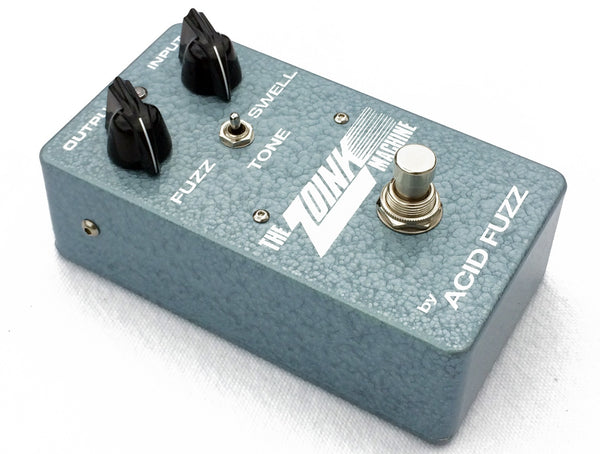
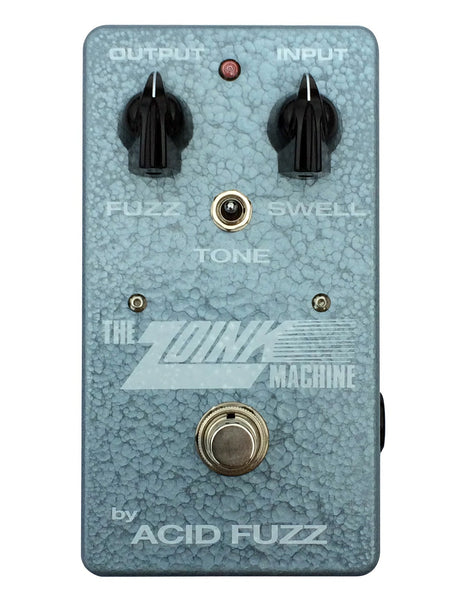
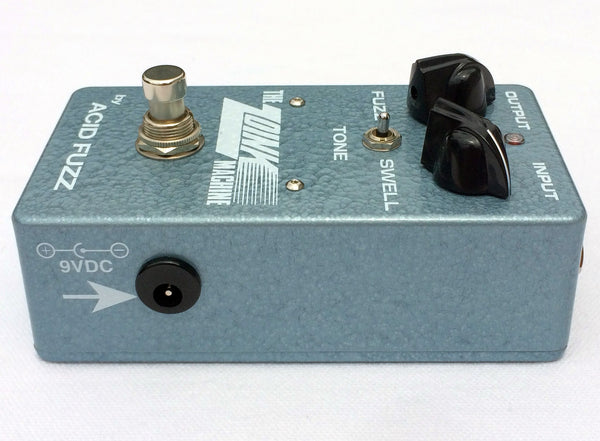
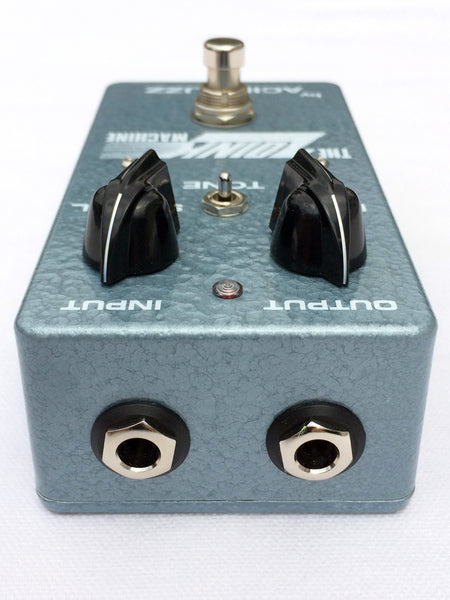
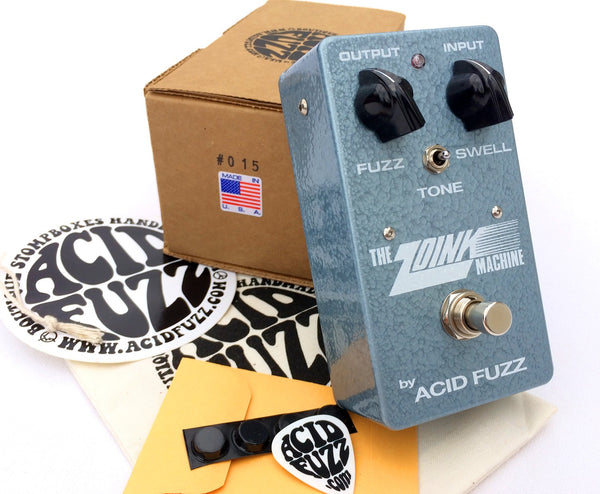
The "Zoink" is a smaller more pedal board friendly version of our Zonk Machine clone, made per request of Doyle Bramhall II.
The sound of this fuzz is very defined and articulate. One of the best fuzz sounds for cutting through a mix and fast lead work where you want to hear all of the subtle details. It's also great for chords without sounding too wooly & muddy. You'll hear all the notes in your chords. Middle position on the "tone" switch is the original Zonk Machine voicing, which is bright, perhaps too bright for some rigs. So, the left position brings in a bit more mids, and right gives you ~the full frequency when used with guitar. We tuned the Zoink for better clean-up with your guitar's volume control, good sustain, and a wider range from the "fuzz" control. This circuit utilizes NOS 1960's germanium transistors in a circuit design that requires current leakage to function. As result, it is extremely temperature sensitive, and not recommended for outdoor gigs where it may be subjected to extreme temperatures.
In addition to the original "FUZZ" and "SWELL" (volume) controls, other features include:
- Tone/voicing switch
- True bypass switching
- LED
- 9V jack
- Compact size at ~4.75" X 2.5" X 2.3".
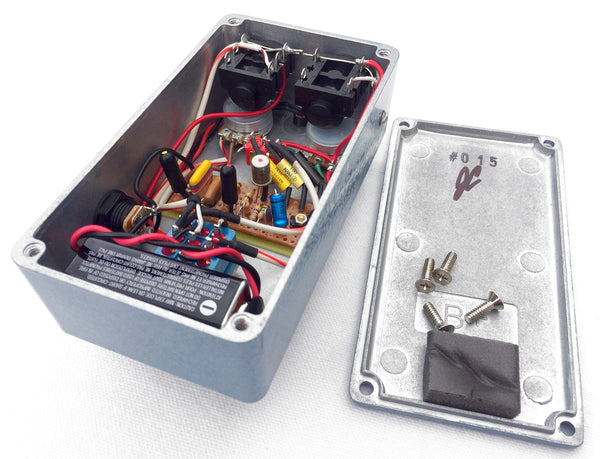
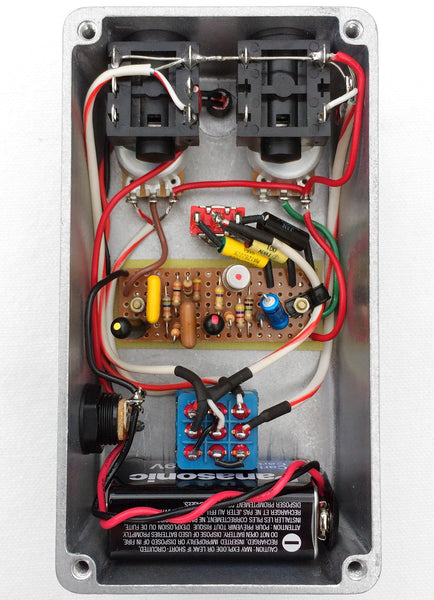
Top quality components throughout including a trio of NOS germanium transistors. Typical transistor sets are one N.O.S. Texas Instruments *TI A02, 2G374 or 2N1379, and black glass Mullard OC75, OC46, or OC71. We are the only manufacturer to have ever used the original Texas Instruments TI A02 germanium transistor found in original Zonk Machines. For me, they were more difficult to source than any other vintage "mojo" germanium transistor.
*NOTE ON TUNINGS: I'm currently offering two distinct tunings, the original/standard Zoink, and the DBII. I made an exact clone of an original 1960's Zonk Machine for Doyle Bramhall II back in 2014. He later requested a smaller pedalboard friendly version for his Europe touring board. That became the Zoink.
Due to it's temperature sensitivity, I initially tuned Doyle's Zoink to be much more open & clean up much better, because I assumed the temperatures he'd experience at gigs in Europe would be lower than we have in Los Angeles. This is the Standard tuning. With standard tuning, the "FUZZ" control works throughout it's travel. Full counter-clockwise gives more of a Tube-Screamer overdrive with excellent clean-up, similar to a Fuzz Face. The standard tuning cleans up much better than any other Zonk Machine I'm aware of, and is best suited for use at room temperature and slightly below. If temperature drops much below room temperature, performance is similar to the DBII tuning at room temp. With standard tuning, the transistors are much more on/conducting than the DBII tuning. Therefore, there will be a bit more background noise at idle than DBII tuning, as the transistors are't in cutoff & gating all noise. This is normal.
Standard tuning is not based on any original Zonk Machine I've played, though there could be a few originals out there with this tuning, as it shares the same factory circuit. For example, the Gibson Maestro FZ-1 Fuzz-Tone is the circuit both the MKI Tone Bender & Zonk Machine are based on. I've bought and sold several FZ-1 Fuzz-Tone's over the years. I've kept two. The two I've kept have what I call the "Standard" tuning for the Zoink. At a temperature of ~75-80°F one of them cleans up to sparkling clean Fuzz Face level at low "ATTACK" settings, and has unbelievable saturation, sustain, & a LOT of character of note decay at higher ATTACK settings. ~Unheard of for a 3 volt fuzz circuit. This FZ-1 is my personal favorite vintage fuzz I own AT ~75-80°F. If ambient temperature creeps above or below that range, it's ~my least favorite. These FZ-1's are unicorns that live in the Goldilocks zone.
"Standard" is my idealized tuning of what the Zonk Machine should be for my ears & playing style. It's not the Doyle Bramhall II Rich Man sound. You want the DBII tuning for that. Standard tuning is based on careful transistor selection to achieve its unique properties. Standard tuning requires painstaking selection of a minimum of dozens of transistors for each pedal. Standard tuned Zoinks take at least 2-3 times longer to audit, and are ~unicorns in terms of rarity of suitable transistors. You need 1,000's of NOS transistors in order to build them in any quantity.
I only sell the original Doyle Bramhall II tuned Zonk Machine clones in the original three-piece enclosures, with the original Texas Instruments TI A02, Mullard OC75 & OC44 transistor sets as auction sales. So, I started offering the "DBII" tuned Zoink for people who want that tuning in the smaller & more available form. The DBII tuning is best suited for room temperature and slightly above. The DBII tuning is more gated & "pinches the note" more, as Doyle describes it. DBII tuning does not clean up anywhere near standard tuning level when rolling off your guitar's volume.
I only sell the original Doyle Bramhall II tuned Zonk Machine clones in the original three-piece enclosures, with the original Texas Instruments TI A02, Mullard OC75 & OC44 transistor sets as auction sales. So, I started offering the "DBII" tuned Zoink for people who want that tuning in the smaller & more available form. The DBII tuning is best suited for room temperature and slightly above. The DBII tuning is more gated & "pinches the note" more, as Doyle describes it. DBII tuning does not clean up anywhere near standard tuning level when rolling off your guitar's volume.
**This pedal is positive ground like the original Zonk Machine and can not be "daisy-chain" powered from one power supply with modern negative ground pedals. You must use a dedicated 9v power supply, an isolated power supply like Voodoo Labs, or just use a battery.
***Please note: This pedal is temperature sensitive & is designed to perform best at a room temperature of ~72-75°F (~22-24°C). At temperatures below this range the sound will be more gated, not clean up as well when rolling off your guitar's volume, and have lower output amplitude. At temperatures above this range the sound will be more open, clean up better when rolling off your guitar's volume, and have higher output amplitude. The noise floor will also increase as temperature increases. This is NORMAL & is the nature of original Zonk Machines. If you want better performance at colder temperatures, the Standard tuning is best suited. If you want better performance at warmer temperatures, the DBII tuning is best suited.
***Please note: This pedal is temperature sensitive & is designed to perform best at a room temperature of ~72-75°F (~22-24°C). At temperatures below this range the sound will be more gated, not clean up as well when rolling off your guitar's volume, and have lower output amplitude. At temperatures above this range the sound will be more open, clean up better when rolling off your guitar's volume, and have higher output amplitude. The noise floor will also increase as temperature increases. This is NORMAL & is the nature of original Zonk Machines. If you want better performance at colder temperatures, the Standard tuning is best suited. If you want better performance at warmer temperatures, the DBII tuning is best suited.